
Entry Point to an Industry: How Local Ferries Launch Maritime Careers
In an area surrounded by water, it is no surprise that the maritime industry is an economic powerhouse in Hampton Roads. Between the Port of Virginia, local shipbuilders, and regional transit operators, the sector boasts hundreds of thousands of jobs.
According to an economic impact analysis conducted by William & Mary, the region’s maritime industry supports more than 700,000 total jobs, nearly $57 billion in income, and over $8 billion in state and local taxes. The industry spans a wide array of fields, including ship repair, port logistics, harbor operations, transportation, and tourism.
“Workforce development continues to be a priority for the industry and for VMA,” says David White, Executive Director of the Virginia Maritime Association.
Fortunately for job seekers in Hampton Roads, two regional ferry systems offer ideal entry points into this thriving maritime ecosystem.
Starting on the Deck: The Elizabeth River Ferry
The Elizabeth River Ferry (ERF) has been a transit staple in Hampton Roads for more than 40 years. Its fleet of four vessels operates between Norfolk and Portsmouth, connecting passengers to employment centers, restaurants, and entertainment venues.
Ferry service between the two cities has existed since the mid-1630s, starting with small rowboats connecting the two cities, making it one of the oldest continuous ferry operations in North America.
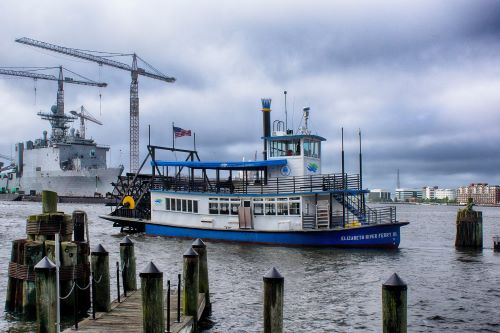
Beyond serving as an economic driver, today’s ferry service acts as a steppingstone for maritime careers. A single summer spent as a deckhand can pave the way to becoming a harbor pilot, tugboat captain, or marine engineer.
Ben Foster, Service Engineer at Norfolk by Boat, which operates the ferry on behalf of Hampton Roads Transit, started as a deckhand at age 15. By 18, he had earned his captain’s license. At 21, he was accepted into the prestigious Great Lakes Maritime Academy at Northwestern Michigan College, one of only seven degree-granting maritime academies in the nation.
Today, Foster mentors young deckhands and leads them on tours of the academy. He also serves as an agent for Carnival Cruise Line when ships dock at Waterside, coordinating operations across a 300-person team of truck drivers, porters, police officers, pilots, and tugboat operators.
Captain Brian Dutton similarly began as a 16-year-old deckhand with ERF, earning his captain’s license by 19. Though he initially didn’t plan on a career on the water, he has now been with the ferry for nearly 25 years.
Over his career, Capt. Dutton has also worked on the Spirit of Norfolk, the Carrie B, a tour boat out of Lynnhaven Inlet, and vessels in Washington, D.C., and Maryland. Since taking the helm, he has guided dozens of deckhands toward earning their licenses.
Emergency Lifeline: North Carolina State Ferry
Further south, residents in coastal North Carolina rely on the North Carolina Department of Transportation (NCDOT) ferry system – the second-largest state-run ferry network in the nation, behind Washington State.
Ferry Division Director Jed Dixon, a Dare County native and U.S. Merchant Marine Academy at Kings Point graduate, worked his way up from a ferry captain in Hatteras to leading the entire division.
Beyond driving tourism and supporting local businesses, more recently the ferry system served as an essential lifeline during severe weather.

In late September when storm overwash washed out 1,000 feet of Highway 12 between the Marc Basnight Bridge and Rodanthe, NCDOT activated its emergency ferry route. Running around the clock, ferries transported over 1,900 people, nearly 1,000 vehicles, and crucial grocery and fuel shipments between Rodanthe and Stumpy Point.
Less than a month later, flooding from subtropical storm Josephine forced the ferry to activate its emergency route again for only the fifth time in 25 years.
Entry-Level Opportunities: Building the Future Workforce
For entry-level workers, the ferry system provides both structured career growth and essential industry exposure.
“Frequently, one job can open the door to other jobs that a person didn’t know about,” White says. “Any entry-level opportunities help to build an ecosystem that generates awareness and creates pathways for people to begin and build their careers in the maritime industry that drives the economy of this region.”
For young deckhands or traffic coordinators considering their next move, Dixon offers clear advice: Be open-minded and willing to take the next step. Show up. Work hard. Ask questions.
Whether connecting commuters across the Elizabeth River or providing emergency transport across coastal sounds, regional ferries do more than move people – they help build the future workforce of the maritime industry.


